WEEK OF SACRED MUSIC 2026. A PLACE WHERE MUSIC, LITURGY AND COMMUNITY MEET
30.08.2026
“Sacred music will be the more holy the more closely it is connected with the liturgical action, whether by adding greater expressiveness to prayer, fostering unity of hearts, or making the sacred rites more solemn.”
(Sacrosanctum Concilium, 112)
“A Living Tradition Today – Music, Liturgy, Community”
From 30 August to 4 September 2026, Zadar hosted the first Week of Sacred Music, a national programme of professional development and fellowship intended for organists, choir directors, singers, and all those involved in creating and shaping liturgical music.
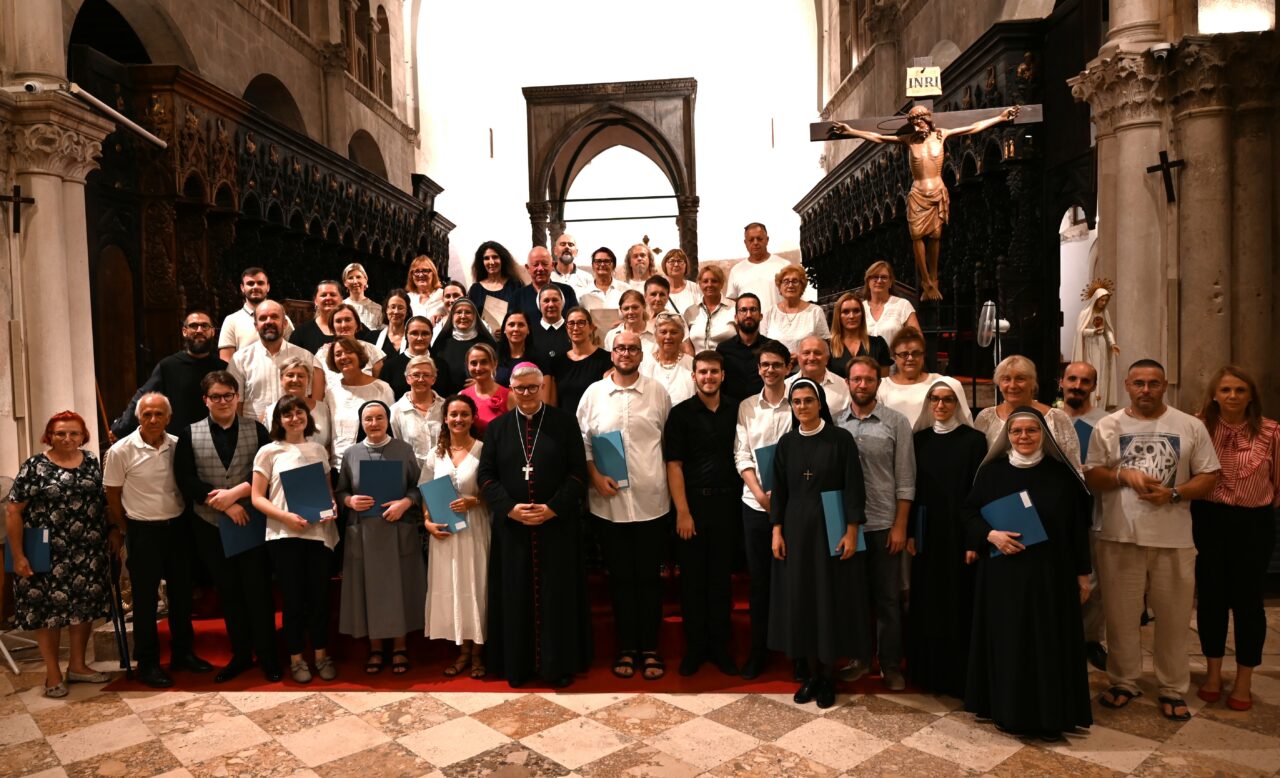
The first Week brought together 42 individual participants from different parts of Croatia and abroad, while approximately 80 people took part in the programme together with the participants of the choral workshops. It was a gathering dedicated to professional development, the exchange of experience and the connecting of church musicians, but also to a deeper understanding of liturgy, prayer and service through music. The Week of Sacred Music was organised by the Ars Organi Association, led by its president and the initiator of the programme, Dragan Pejić, in cooperation with the Archdiocese of Zadar, headed by Archbishop of Zadar Mons. Milan Zgrablić; the Parish of St Anastasia and its parish priest, Rev. Josip Radojica Pinčić; the “Vicko Zmajević” Archdiocesan Seminary and its rector, Rev. Dr Ante Sorić; and the Croatian Society of Church Musicians, whose secretary is Ivon Fabijanec. The programme was held with the approval of the Ministry of Science, Education and Youth of the Republic of Croatia.
A Gathering that Began with Community
The first Week of Sacred Music began on Sunday, 30 August, with the participants gathering in the hall of the “Vicko Zmajević” Archdiocesan Seminary. The welcome programme was led by Jolida Klarić on behalf of the Ars Organi Association, greeting the participants and introducing them to a programme that, over the course of six days, brought together lectures, workshops, practical work, liturgical celebrations and communal music-making. In his opening address, Dragan Pejić, president of the Ars Organi Association and initiator of the Week of Sacred Music, emphasised the importance of establishing a gathering that brings together professional development, liturgy, musical heritage and fellowship among church musicians. The participants were then addressed by Rev. Dario Tičić, head of the Commission for Liturgy and Church Music of the Archdiocese of Zadar, who spoke about the importance of liturgical music and its place in the life of the Church. On behalf of the Croatian Society of Church Musicians, the participants were welcomed by its secretary, Ivon Fabijanec, who also introduced the lecturers and presented the content of the various programmes.
Following the opening addresses and presentation of the Week of Sacred Music schedule and programme, the participants had an opportunity to get to know one another. The first gathering concluded with fellowship and a reception at the seminary, emphasising from the very beginning one of the fundamental values of the Week of Sacred Music, alongside professional development: creating a space for encounter, the exchange of experience and the connection of people whose work serves the liturgy and sacred music.
Seven Areas of Professional Development
The Week’s programme was divided into seven areas: choral technique and choir work, liturgy, Gregorian chant and psalmody, vocal technique, liturgical organ playing and improvisation, conducting, and Gregorian chants in handwritten and printed liturgical books.
Choral technique and choir work were led by Stjepan Molnar, MA; liturgy by Ivon Fabijanec, MA in Music, MA in Sacred Music, MA in Theology; Gregorian chant and psalmody by Sr Josipa Pavla Jakić, MA; and vocal technique by Vlatka Kladarić, MA in Music. Liturgical organ playing and improvisation were led by Nikola Cerovečki, MA in Art, MA, while the area of Gregorian chants in handwritten and printed liturgical books was led by Br. Bartol Mihael Beban, MA in Musicology. Conducting included individual work and practical exercises with several instructors. The work was carried out through lectures, workshops, practical exercises and individual study. Participants had the opportunity to develop their musical and liturgical competencies and to exchange experiences from their own practice. A special part of the programme consisted of choral workshops involving members of the Mixed Cathedral Choir of St Anastasia and the Sacred Heart of Jesus Choir, together with participants of the Week of Sacred Music. In this way, professional work was directly connected with the practical experience of making music together.
Zadar as a Place of Liturgical and Musical Heritage
The Cathedral of St Anastasia, the mother church of the Archdiocese of Zadar and the largest church in Dalmatia, provided a particularly valuable setting for the programme. Its centuries-old liturgical and musical tradition, together with its great cathedral organ, offered participants a direct experience of a space where liturgy, music and art meet. Numerous local collaborators also contributed to the implementation of the programme. The Benedictine Sisters played an active role in organising the Week, made the organ in the Church of St Mary available for part of the programme, and actively participated in the workshops and professional work of the seminar. They presented the participants with the permanent exhibition of church art, “The Gold and Silver of Zadar”, and welcomed them to the Monastery of St Mary. The Parish of St Simeon also provided a venue and an organ for part of the programme. In this way, the professional work was connected with different spaces and custodians of Zadar’s rich liturgical and cultural heritage.
A Living Tradition Today
The theme of the first Week, “A Living Tradition Today – Music, Liturgy, Community”, directed the programme towards the question of how the Church’s valuable musical heritage can be preserved, understood and lived in the present day. Gregorian chant, psalmody, polyphony, organ music, Croatian liturgical heritage and Glagolitic chant were not viewed merely as part of the past, but as a living heritage that continues to have its place in the liturgy today. At the same time, the contemporary church musician needs to understand the liturgy, develop musical skills and be prepared to respond to the needs of the community they serve. The connection between tradition and the present was therefore one of the important characteristics of the Week. Professional knowledge, practical work, liturgical formation and fellowship were not separate elements, but interconnected parts of the same endeavour: for sacred music to be of high quality, rooted in the liturgy and directed towards prayer and the praise of God.
The Closing Celebration: Solemn Mass and a Concert by the Participants
The Week of Sacred Music concluded on 4 September with a solemn Eucharistic celebration in the Cathedral of St Anastasia, presided over by the Archbishop of Zadar, Mons. Milan Zgrablić. Concelebrating were the parish priest, Rev. Josip Radojica Pinčić, and the Vicar General, Rev. Dr Ante Sorić.
In his homily, the Archbishop spoke about the meaning of liturgical music through the Gospel image of the Bridegroom and the new wine. He reminded the participants that music in the liturgy is neither an end in itself nor an ornament of the celebration, but a service to the encounter with Christ. The beauty of music can lift the gaze and heart towards God, but music must never overshadow the liturgy; rather, it should serve the Word of God and the liturgical action. Speaking of “new wine into new wineskins”, he emphasised the need to preserve Gregorian chant, polyphony, organ music and Croatian liturgical heritage, while remaining open to new generations, new composers and new forms. He also recalled the words of Pope Leo XIV about the need to lift our eyes and gaze towards Heaven. Archbishop Zgrablić gave particular thanks to Dragan Pejić as the initiator and driving force behind the Week of Sacred Music, as well as to all the lecturers, collaborators and participants who contributed to its realisation.
Following the Eucharistic celebration, the participants gave a concert, after which Archbishop Mons. Milan Zgrablić personally presented them with certificates of participation and certificates of appreciation. This brought the first Week of Sacred Music to a close, a gathering that, over the course of six days, brought together professional work, liturgy, musical heritage and community. At the “Vicko Zmajević” Archdiocesan Seminary, where the Week had also begun, the final gathering continued in an atmosphere of gratitude and fellowship with a reception.
The Week of Sacred Music Continues
The very positive impressions of the participants and the strong interest in this form of professional development demonstrated the value of establishing the Week of Sacred Music, which will continue next year. Its aim is to foster lasting connections among church musicians from Croatia and abroad through professional development and the exchange of experience, while deepening the understanding of music as an integral part of the liturgical life of the Church. The Week of Sacred Music forms part of the broader activities of the Ars Organi Association, developed alongside the Orgulje sv. Stošije Festival. Alongside festival concerts and masterclasses, the Week provides a space for the systematic education of church musicians, the exchange of experience and the connection of those whose work contributes to the liturgical life of the Church. At the heart of this activity are the great cathedral organ and its liturgical service. The programme was initiated and developed by Dragan Pejić, president of the Ars Organi Association and permanent cathedral organist, with the aim of bringing together liturgy, the art of the organ, professional education and the Church’s musical heritage around the Cathedral of St Anastasia. In this way, a comprehensive programme is gradually taking shape in which concert and educational activities, the promotion of organ music and the preservation of sacred musical heritage naturally build upon the Cathedral’s liturgical life and its service to worship.
The importance of liturgical music lies not only in its artistic value, but above all in its connection with the liturgy. The Second Vatican Council, in the Constitution Sacrosanctum Concilium, emphasises sacred music as an integral part of the liturgical celebration and particularly highlights the value of the Church’s musical heritage, Gregorian chant, choirs, and musical and liturgical formation.
Pope Leo XIV has likewise recalled this mission, emphasising the importance of sacred music in the life of the Church. Music in the liturgy is not merely an addition or ornament, but participates in the celebration itself and helps the community of believers to unite in prayer. The task of the church musician therefore goes far beyond simply performing music: it is a service to the liturgy, the community and God.
It is precisely in this understanding that the meaning of the Week of Sacred Music can be found. Choral technique, liturgy, Gregorian chant, vocal technique, conducting, liturgical organ playing, improvisation and the study of liturgical repertoire are not ends in themselves. Everything is directed towards ensuring that music in the liturgy is of high quality, dignified and truly at the service of the celebration. The first Week of Sacred Music thus opened a new space for the systematic education and connection of church musicians and demonstrated how, alongside the regular liturgical life of the Cathedral of St Anastasia, activities can be developed that enrich its musical and cultural life, always proceeding from its fundamental purpose: the celebration of the liturgy.
Ad maiorem Dei gloriam!
Workshop Programme and Lecturers
The workshops are led by distinguished church musicians, educators and experts with extensive artistic and academic experience. The programme is designed to combine theoretical knowledge, practical work and the experience of collective music-making, providing participants with opportunities for personal development and the improvement of their service in church music.
Choral Technique and Choir
Lecturer: Stjepan Molnar, MA
Duration: 5 days
Workshop Description
Through practical work, participants in the choir and choral technique workshop will develop vocal and musical skills necessary for high-quality choral singing. Special emphasis will be placed on proper breathing, vocal placement, intonation, articulation and achieving a unified choral sound.
Through collective music-making, participants will learn how to achieve vocal balance, shape dynamics and develop expressive interpretation. The workshop will also include basic elements of conducting and choir leadership, with the aim of understanding the relationship between the conductor and the choir, as well as the importance of non-verbal communication in performance. Participants will work on the preparation and interpretation of selected choral compositions under expert guidance, including performance analysis and feedback. The aim of the workshop is to strengthen the technical and musical competencies of singers and choir leaders, while encouraging unity and artistic expression through the experience of collective singing.
Lecturer Biography
STJEPAN MOLNAR, MA
Stjepan Molnar was born in Zagreb, where he completed his organ studies at the Vatroslav Lisinski Music School in the class of Professor Jasna Šumak-Picek. He continued his studies of organ and church music at the University of Music and Performing Arts Graz, where he studied with Professor Gunther Rost. He is a multiple recipient of the “Martha Debelli” Award and a scholarship holder of the City of Graz. During his studies, he performed as a soloist at numerous concerts and festivals, as well as in collaboration with various choirs and ensembles.
As a conductor, he has led several choirs and conducted numerous major works from the sacred music repertoire. He currently serves as Regens Chori at the Benedictine Abbey of St. Paul im Lavanttal and as regional cantor of the Diocese of Gurk-Klagenfurt. Since 2025, he has also taken over the artistic direction of the renowned “Kultursommer St. Paul” festival.
Liturgy
Lecturer: Ivon Fabijanec, mag. mus., mag. mus. eccl., mag. theol.
Duration: 5 days
Workshop Description
The liturgy workshop will focus on reflection and practical musical formation of liturgical celebrations. Through the analysis of liturgical texts, symbols and the structure of rites, participants will learn how to harmoniously connect music, word, prayer and space into a unified whole that encourages the active participation of the community. Special emphasis will be placed on planning and preparing concrete liturgical celebrations according to the liturgical year, as well as on understanding the role of different ministries and cooperation within the liturgical team.
Participants will have the opportunity to independently design outlines for particular liturgical celebrations, with professional guidance and shared reflection. Through practical examples, discussions and collaborative work, they will develop sensitivity for the aesthetic, spiritual and pastoral dimensions of the liturgy. The workshop encourages an understanding of liturgy as a living and dynamic encounter of the community with God, which is shaped thoughtfully, creatively and responsibly.
Lecturer Biography
IVON FABIJANEC, mag. mus., mag. mus. eccl., mag. theol.
Ivon Fabijanec was born in Koprivnica. He completed secondary music education at the Varaždin Music School, graduating in organ and music theory. In 2013, he enrolled in the Philosophy and Theology programme at the Catholic Faculty of Theology of the University of Zagreb, where he obtained a Master’s degree in Theology in 2019.
In the same year, he enrolled in the undergraduate programme in Church Music – Music Pedagogy at the Institute for Church Music of the Catholic Faculty of Theology, obtaining his Bachelor’s degree in 2022. He continued his studies in music pedagogy at the Department of Music Pedagogy and Tamburitza Instruments at the Academy of Music of the University of Zagreb, where he obtained the title of Master of Music Pedagogy (univ. mag. mus.) in 2024 after defending his thesis entitled “The Use of Gregorian Chants in Solfeggio Teaching.” In the same year, by defending his thesis “The Liturgical Drama Visitatio sepulchri in the Manuscripts of the Zagreb Metropolitan Library,” he obtained the title of Master of Church Music (univ. mag. mus. eccl.).
He is the recipient of the Dean’s Award for the best student work entitled “Church Singing in the Parish of the Holy Trinity – Legrad.” He serves as secretary of the Croatian Society of Church Musicians and is a member of the Supervisory Board of the Christian Culture Festival Pasionska baština. He is the organist of the Parish of the Assumption of the Blessed Virgin Mary (Shrine of Our Lady of Močile) in Koprivnica–Močile, where he leads the children’s choir and youth choir. He is also the organist of the Parish of the Holy Trinity in Legrad, where he leads the mixed parish choir, and he serves as conductor of the city mixed choir “Podravina” in Ludbreg. His most recent research on liturgical drama was presented as an example of a Croatian medieval liturgical source in the Croatian Radio programme “Tragovima glazbe” by editor Dr. Hana Breko Kustura. He has published several articles on sacred music in the journal Sveta Cecilija, dedicated to church music.
Gregorian Chant and Psalmody
Lecturer: Sr. Josipa Pavla Jakić, MA
Duration: 5 days
Workshop Description
In the Gregorian chant and psalmody workshop, participants will become familiar with the fundamentals of interpreting and performing Gregorian chants, as well as with the principles of psalm singing within the liturgical context. Through practical work, participants will learn about modality, rhythm and phrasing in Gregorian chant, as well as the relationship between text and melody in the service of prayer. The workshop will also include the analysis of Gregorian notation (neumes), an understanding of the liturgical framework in which Gregorian chant is performed, and the application of psalmody in various forms of worship.
Participants will work on the performance of selected chants, with particular emphasis on the spiritual dimension and simplicity of expression that arises from the tradition of sacred chant. The aim of the workshop is to deepen the understanding of the Gregorian heritage and psalmody as a source of prayer, meditation and communal celebration.
Lecturer Biography
S. JOSIPA PAVLA JAKIĆ, MA
S. Josipa Pavla Jakić, a member of the religious community of the Sisters of Mercy of the Holy Cross, dedicates herself with great passion and commitment to music and spirituality. She began her musical education in Croatia and continued and completed her studies in Austria at the renowned University of Music and Performing Arts Vienna (mdw). During her Master’s studies in Church Music, she specialised in organ and improvisation, Gregorian chant, and choir and ensemble conducting. Throughout her studies, she further developed her skills through numerous international courses and seminars in conducting (Voces8), improvisation (Rudolf Lutz) and Gregorian chant (Inga Behrendt).
As a student, she conducted the Chor Unisono Wien and served as director of church music at the Monastery of the Visitation of Mary in Vienna. She received an honorary award from the Austrian Federal Ministry for Women, Science and Research for outstanding achievements during her studies. She currently teaches organ and choir at the Josip Runjanin Music School in Vinkovci, as well as organ, conducting and singing at the Archdiocesan Music School in Đakovo. She has participated several times as a lecturer at the Week of Church Music and Choral Singing in Austria, where she led workshops in Gregorian chant, psalmody and conducting. As an active performing artist, Sr. Josipa Pavla Jakić regularly performs in Croatia and abroad as an organist, improviser and conductor. She is the founder of the ensemble Greg8, dedicated to the performance of Gregorian chant and early music.
Alongside her concert activities, she is actively involved in church music. She serves as cathedral organist at the Cathedral of St. Peter in Đakovo and as director of the convent choir and church music programme at the Monastery of the Sisters of Mercy of the Holy Cross in Đakovo.
Vocal Technique – Individual Workshop
Lecturer: Vlatka Kladarić, mag. mus.
Duration: 5 days
Workshop Description
Through individual work with the lecturer, participants in the vocal technique workshop will develop and improve their singing abilities. The workshop focuses on proper breathing, vocal placement, resonance, articulation and expansion of vocal range, with an approach adapted to the needs and level of each participant. Through practical exercises and individual guidance, participants will work on technical stability, expressive abilities and interpretation of selected vocal repertoire. Special emphasis will be placed on healthy and natural use of the voice, as well as understanding the connection between body, breath and sound. The aim of the workshop is to encourage personal vocal development, confidence in singing and greater awareness of individual vocal possibilities.
Lecturer Biography
VLATKA KLADARIĆ, mag. mus.
Vlatka Kladarić (soprano) was born in 2001 in Đakovo, where she received her initial musical education in piano at the Ivan Goran Kovačić Primary Music School.
From her first year at the Franjo Kuhač Secondary Music School in Osijek, in the class of Associate Professor Vesna Coufal Jaić, she has received numerous awards at national and international competitions. Among them are the Bruna Špiler Solo Singing Competition in Herceg Novi, where she won first prize in the trio category (overall winners of the competition) and second prize in the solo category; the 3rd International Vera Kovač Vitkai Solo Singing Competition in Novi Sad, where she won first prize with 98 points; and the Polyhymnia Competition in Skopje, where she received first prize with 99 points and was named laureate of the competition. She also won first prize at the 55th National Competition of Students of Music and Dance in Zagreb.
Since 2012, she has actively participated in the musical life of the Đakovo Cathedral as a singer and musician. In 2019, she graduated in singing and was named the student of the generation at the Franjo Kuhač Secondary Music School in Osijek. That same year, she enrolled in the Music Pedagogy programme at the Academy of Music, University of Zagreb, and in 2020 she began studying singing in the class of Associate Professor Martina Zadro. She has participated in numerous academic projects awarded with the Rector’s Award, including:
Suor Angelica et autres sœurs – a collage project (2021), led by Mladen Tarbuk,
Kuljerić’s The Animal Farm (2022),
Papandopulo’s Amfitrion (2023).
At the 3rd International Stojan Stojanov Gančev Competition in 2023, she won second prize and a special award – a performance with the Zagreb Chamber Orchestra.
In June 2023, she held a solo recital at the Vinko Lesić Young Musicians Cycle in Split, and she performed as a soloist at the concert A Musical Journey through Europe commemorating the 10th anniversary of the accession of the Republic of Croatia to the European Union, organised by the University of Zagreb.
Since 2024, she has performed as an external member of the choir of the Zagreb City Theatre Komedija and the Croatian Radiotelevision Choir. Since June 2024, she has been a member of the ensemble of the Zagreb City Theatre Komedija.
In September 2024, she completed her Master’s degree in Music Pedagogy at the Academy of Music. In December of the same year, she performed at a Christmas concert at the Journalists’ Home in Zagreb with the Zagreb Chamber Orchestra.
In February 2025, she participated as a soloist in the project Opera and Nature, conducted by Mladen Tarbuk and Marius Behrends, which received the Rector’s Award. In March 2025, she made her opera debut in the children’s opera A Voice from Silence by K. Klarić at the Vatroslav Lisinski Concert Hall, performing the role of Clara.
In April 2025, she graduated and made her debut as Diana in J. P. Rameau’s opera Hippolyte et Aricie in a production by the Academy of Music, a project awarded with the Rector’s Award. In the same production, in October 2025, she performed second soprano in M.-A. Charpentier’s Te Deum.
She performed at the gala concert The World Is Mine by Alf(i) Kabiljo with the Zagreb Philharmonic Orchestra at the Vatroslav Lisinski Concert Hall in 2024.
She collaborates with numerous distinguished conductors, including Mladen Tarbuk, Miran Fortuna, Ivan Skender, Tomislav Fačini, Zlatan Vauda, Alfi Kabiljo, Dario Appelt, Damir Kelić and Hermann Albrecht, as well as directors Marius Behrends, Dora Ruždjak Podolski and Krešimir Dolenčić.
Liturgical Organ Playing and Improvisation – Individual Workshops
Lecturer: Nikola Cerovečki, mag. art., MA
Duration: 5 days
Workshop Description
In the workshop on liturgical organ playing and improvisation, participants will develop skills in organ accompaniment and the creative shaping of the organist’s role within the liturgy.
Through practical work, various approaches to organ playing in the liturgical context will be explored – from accompanying congregational singing and choral works to solo performances. Special emphasis will be placed on the art of improvisation, understanding the liturgical season and the dynamics of worship, as well as adapting musical expression to the context of the rite. Through examples and practical exercises, participants will learn how to spontaneously create musical transitions, introductions and endings, and how to harmonise technical and expressive elements with the spiritual message of the liturgy.
The aim of the workshop is to equip musicians for thoughtful, sensitive and creative participation in the shaping of liturgical music.
Lecturer Biography
NIKOLA CEROVEČKI, mag. art., MA
Nikola Cerovečki earned his Master’s degree in organ performance at the Academy of Music, University of Zagreb, in the class of Ljerka Očić. He continued his postgraduate studies at the University of Music and Performing Arts Graz (Kunstuniversität Graz), where he graduated in the class of Gunther Rost and obtained the title Master of Arts. He has participated in numerous masterclasses in organ interpretation led by renowned artists such as Christoph Bossert, Ludger Lohmann, Nathan Laube, Hans Fagius and Martin Schmeding. Among his most important achievements are first prizes at regional and national competitions organised by the Croatian Association of Music and Dance Schools (HDGPP), awards at the Martha Debelli Competition, as well as the award of the Croatian Composers’ Society for the best performance of a composition by Anđelko Klobučar at the Darko Lukić – Young Artists’ Forum at the Vatroslav Lisinski Concert Hall.
As a soloist, he regularly performs at numerous festivals in Croatia, Austria, Germany, Italy, Hungary and Slovenia. Particularly notable are his performances within concert series and festivals such as Organs of Zagreb Cathedral, Young Artists at Lisinski, organ@Mumuth, Orgelfrühling Steiermark, Orgeltriduum Hamm, Siegburger Orgelzyklus, Nei Suoni dei Luoghi, and the Don Petar Nakić Organ Festival.
Alongside his extensive concert activities, he works as organist of the Franciscan Church in Graz and teaches organ at the Helmut Schmidinger Music School in Graz.
Conducting – Individual Workshop
Lecturers: Various lecturers
Duration: 5 days
Workshop Description
In the conducting workshop, participants will develop the technique and expressiveness necessary for effective leadership of a choir or ensemble through individual work with a mentor.
The workshop focuses on acquiring basic and advanced conducting gestures, clarity of movement, rhythmic precision and interpretative freedom. Through practical exercises and work on specific musical material, participants will learn how to connect gesture with musical expression, develop communication with the choir and shape the sound according to an artistic vision. Special emphasis will be placed on coordination, phrasing, dynamics and score preparation. The aim of the workshop is to strengthen the confidence, musical understanding and personal style of each developing conductor through an individualised approach.
Gregorian Chants in Manuscript and Printed Liturgical Books
Lecturer: Br. Bartol Mihael Beban, mag. musicol.
Duration: 5 days
Workshop Description
In the workshop on Gregorian chants in manuscript and printed liturgical books, participants will become familiar with the rich history of this musical genre, which is most closely connected with the Roman liturgical tradition throughout its long development. The workshop will follow the evolution of Gregorian chant from the first systematic neumatic notations of the 11th century, through the decline of the repertoire after the Council of Trent in the so-called Medicean edition, to contemporary liturgical books such as the Graduale Triplex and the most recent Graduale Novum.
Special attention will be given to the work of the Benedictine monks of Solesmes, who, at the end of the 19th and beginning of the 20th centuries, devoted themselves to the restoration of Gregorian chant based on the earliest medieval manuscripts.
Through visits to important collections of such materials in Zadar, especially Franciscan and Beneventan collections, participants will have the opportunity to see selected chant manuscripts in person and become acquainted with their codicological, palaeographical, liturgical, artistic and notational characteristics. The aim of the workshop is to deepen knowledge of Gregorian chant within its historical context and, through direct engagement with manuscript and printed liturgical books (especially those currently available for use, as well as online resources), to introduce participants to valuable tools that can support the musical formation of liturgical celebrations.
Lecturer Biography
BR. BARTOL MIHAEL BEBAN, mag. musicol.
Br. Bartol Mihael Beban, OSB, a monk of the Benedictine Monastery of Ćokovac, obtained the title of Master of Musicology and Professor of Music History at the Academy of Music, University of Zagreb. From 2009 to 2017, he worked at the same institution as an assistant at the Department of Musicology, teaching courses such as Music of Antiquity and the Middle Ages, Croatian Medieval Music, Early Music Notation, and related subjects.
He is currently completing his doctoral dissertation at the University of Music and Performing Arts Graz in the field of medieval music studies, focusing comparatively on the repertoire of Dominican chant from medieval antiphoners preserved in Dalmatia. He has presented papers at numerous international and national scholarly symposia and has published several academic articles in Croatian and international publications.
From 2011 to 2017, he was a member of the Oratorio Choir of St. Mark’s Church in Zagreb, Cantores Sancti Marci, where he also served as prefect for five years. During this period, the choir achieved numerous performances in regular Sunday liturgies, concerts and competitions, achieving notable success at the international level.


