IN HONOR OF ST. ANASTASIA: AN EVENING OF CROATIAN COMPOSERS ON THE GREAT CATHEDRAL ORGAN
14.01.2027
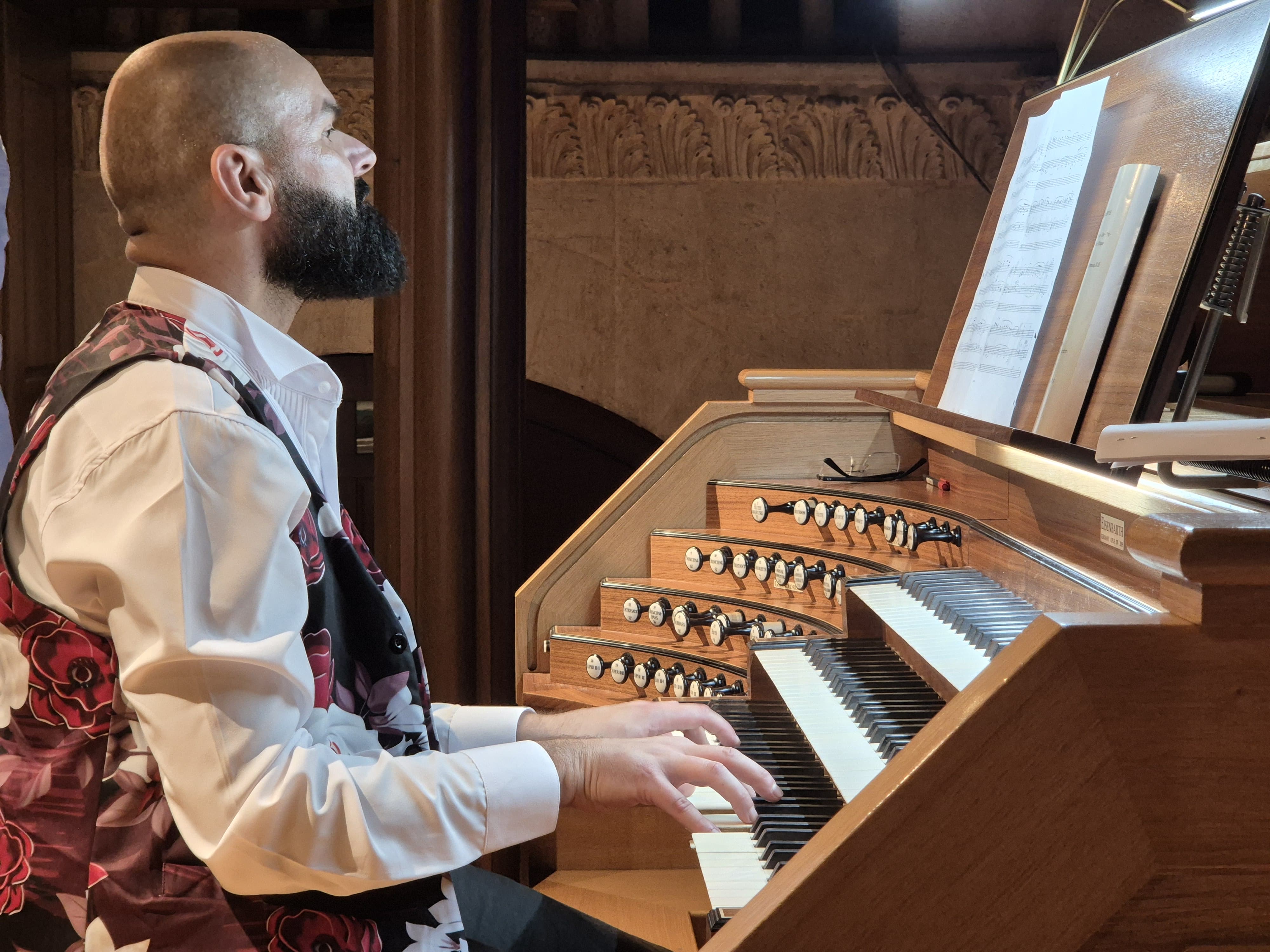
For the fifth consecutive year, we are giving the city of Zadar a special musical gift: an organ concert on the eve of the Feast of St. Anastasia.
On the eve of the feast, January 14, 2027, following Solemn Vespers in the Cathedral of St. Anastasia, presided over by the Archbishop of Zadar, Mons. Milan Zgrablić, an Evening of Croatian Composers will be held. Alen Kopunović Legetin will perform on the expanded Great Cathedral Organ of St. Anastasia, which will, following its upgrade, resound in its full glory. He will perform works by Croatian composers, with the concert concluding with an improvisation on themes from Croatian Christmas carols.
St. Anastasia, also known as Anastasia of Sirmium, was a martyr from Sirmium who gave her life for her faith during the persecution under Emperor Diocletian. In 810, Bishop Donatus of Zadar received her relics from the Byzantine Emperor Nikephoros and brought them to Zadar. Since then, the holy relics of St. Anastasia have been preserved in Zadar Cathedral, which was named after her.
St. Anastasia is the patron saint of the Archdiocese of Zadar and the patroness of the Cathedral of St. Anastasia, and her feast is celebrated on January 15. In Zadar, the Christmas season traditionally continues until her feast day. Until then, families keep their Christmas trees in their homes, while Christmas carols continue to be sung in churches. For this reason, the concluding improvisation on themes from Croatian Christmas carols naturally connects the Christmas season with the preparation for the Feast of St. Anastasia, which traditionally marks the end of the Christmas season in Zadar.
Alen Kopunović Legetin, an outstanding and versatile Croatian organist, has prepared a new themed musical evening: An Evening of Croatian Composers.
The programme offers a carefully selected survey of Croatian organ and sacred music heritage, bringing together composers from the 18th century to the present day. Spanning different stylistic periods, pastoral and traditional motifs, and works inspired by sacred musical heritage, it reveals the diversity of Croatian organ music and its connections with liturgical and folk musical traditions.
CROATIAN COMPOSERS FOR ORGAN – PROGRAMME NOTES
This programme represents an exceptionally valuable, carefully selected anthology of Croatian organ and sacred music heritage, enriched by traditional influences and the living practice of improvisation. Unlike the usual cosmopolitan programmes (Bach – Reger – Widor), this concert is deeply rooted in the national musicological context, bringing together composers from the 18th century to the present day, with a clear focus on sacred and pastoral themes.
The musicological analysis of this programme reveals several key structural and stylistic strands:
1. Historical Continuity and Stylistic Pluralism
The programme spans a wide range of stylistic periods, requiring the performer to demonstrate a high degree of stylistic adaptability.
Baroque and Classicism (Early Sources): Luka Sorkočević introduces the spirit of pre-Classical symphonism and the galant style through his studies (adapted for organ), while the Franciscan friar Fr. Fortunat Pintarić and Leopold Ebner represent the early Croatian organ heritage of the transition from the 18th to the 19th century.
Croatian Modernism and the Cecilian Movement: The works of Fr. Anselmo Canjuga, a Capuchin friar who met a tragic end, and academician Albe Vidaković represent the pinnacle of 20th-century Croatian sacred music. Canjuga’s Fuga in g reflects strict contrapuntal discipline, while Vidaković’s works combine grandeur with a synthesis of Neo-Romantic and Neo-Baroque styles.
A Contemporary Voice: Blaženko Juračić brings a contemporary compositional sensibility that remains deeply rooted in Gregorian chant and the old Croatian musical tradition.
2. Pastoral and Folk Archetypes (“Kolo”, “Dudaš” and “Pastorella”)
A particularly interesting musicological thread running through this programme is the pastoral character of several works, reflecting a centuries-old tradition in organ music, especially during the Christmas season.
Stanislav Preprek (Pastirsko kolo): This work combines the traditional circle dance (kolo) with the distinctive modal melodies of Vojvodina and the Syrmian region, where the composer was active.
Leopold Ebner (Rondo Pastorella): This work, coloured by the Classical style, evokes an idyllic pastoral atmosphere characteristic of the sacred music of northern Croatia during that period.
Fr. Fortunat Pintarić (Dudaš in F major): A witty and vivid work, rich in imitation of a traditional folk instrument—the bagpipes. From a performance perspective, the choice of stops is crucial in faithfully evoking the bordun (a sustained drone) and the penetrating sound of the bagpipes.
3. Formal Structure versus Organ Improvisation
The programme strikes a balance between fixed, rigorous forms and the freedom of spontaneous musical creation.
Albe Vidaković as the Pillar of the Programme: His Prelude and Fugue in C major, and particularly the extensive Fantasy and Fugue in F minor, represent the most technically and architecturally demanding works in the programme. In these forms, Vidaković, a key Croatian musicologist and composer, demonstrates a profound understanding of Bachian counterpoint, transformed into a dramatic, more modern musical idiom.
The Art of Improvisation (Čalo and Legetin): Organ improvisation is one of the instrument’s most demanding disciplines. Andro Čalo and Alen Kopunović Legetin, both distinguished contemporary organists, draw on a living tradition of improvisation. The choice of themes (“Veseli se, Majko Božja” and Croatian Christmas carols in general) suggests that the programme also has a strong liturgical and seasonal connection, possibly related to Christmas or Marian devotion.
4. A Dialogue with Heritage: Cithara Octochorda (1701)
Blaženko Juračić’s composition Zdrava Devica, Bogorodica provides a direct link to the earliest written sources of Croatian vernacular sacred music. The variations on a theme from Cithara Octochorda, the most important Croatian Baroque hymnbook (1701 edition), are of particular musicological interest, as the composer uses the historical monophonic melody as a cantus firmus, building a contemporary sound world around it through modern layers of registration and harmony.
This programme is therefore more than a concert: it is a major musicological project celebrating the authentic identity of Croatian organ music across the centuries.
Concert Programme:
Josip Vrhovski
Predigra
Stanislav Preprek
Pastirsko kolo
Albe Vidaković
Preludij i fuga C-duru
Blaženko Juračić
Zdrava Devica, Bogorodica
(varijacije na temu iz Cithare Octochorde, 1701.)
Leopold Ebner
Rondo Pastorella
Andro Čalo
Improvizacija na temu „Veseli se, Majko Božja"
o. Fortunat Pintarić
Dudaš u F-duru (Joueur de cornemuse)
Albe Vidaković
Fantazija i fuga u f-molu
Luka Sorkočević
Dvije studije
I.Moderato
II. Allegretto
o. Anselmo Canjuga
Fuga u g-molu
A. K. Legetin
Improvizacija na teme hrvatskih božićnih pjesama
Biography
Alen Kopunović Legetin (Subotica, 29 October 1974) is a Croatian organist, choirmaster, composer, pedagogue and promoter of sacred and concert music, an artist who has built a distinctive and powerful artistic profile on both the Croatian and international music scene over the course of his long career. His professional activity encompasses concert organ performance, liturgical music, composition, pedagogy, and the artistic direction of various musical ensembles and projects. At the centre of his work stands the art of the organ — an instrument that, in his artistic approach, becomes a medium of profound musical, spiritual and aesthetic expression.
Alen Kopunović Legetin holds a distinguished place on the Croatian music scene as an organist, choirmaster, composer and promoter of church and concert music. His artistic personality has been shaped through a synthesis of discipline, emotion, spirituality and high artistic ambition. This combination has resulted in an interpretative style that simultaneously respects tradition while seeking a personal artistic truth. As an organist, he is known for his monumental sound, pronounced interpretative dramaturgy, and his ability to bring complex musical works closer to a wider audience without compromising their artistic depth.
Musical Education
He received his primary and secondary music education in Subotica, where he completed music school in both the theory and piano departments. He continued his organ studies at the Academy of Music of the University of Zagreb, graduating in 1997 in the class of Ljerka Očić. For his artistic achievements, he received the Rector’s Award of the University of Zagreb. During his studies, he served as organist at the Minor Seminary on Šalata and at St Mark’s Church in Zagreb, gaining valuable liturgical and concert experience.
He further pursued his education in an international environment. In the academic year 1998/1999, he undertook advanced studies at the Universität Mozarteum Salzburg under Elisabeth Ullmann, and later continued his specialization in church music at the Pontifical Institute of Sacred Music in Rome with Fr Theo Flury.
Liturgical and Pedagogical Activity
From 1999 to 2016, he served as organist and choirmaster of St Lawrence Church in Požega and as Pontifical Organist of the Diocese of Požega. During this period, he made a significant contribution to the development of the musical life of both the city of Požega and the diocese. He worked as conductor of the Croatian Cultural and Artistic Society Vijenac Požega, artistic director of the Požega Organ Evenings festival, and professor at the Požega Music School, where he taught organ, choir and piano.
From 2017 to 2020, he served as organist and choirmaster of the Parish of the Annunciation of the Lord in Zagreb, and from 2023 to 2025 as organist and choirmaster of St Maximilian Kolbe Parish in Zagreb.
Pedagogical work occupies an important place in his artistic activity. As a professor and mentor, he has educated new generations of musicians, transmitting knowledge, experience and high aesthetic standards.
Concert Activity
As a concert organist, he has developed an extensive solo and chamber career. He performs regularly throughout Croatia and Europe and has appeared as a soloist with ensembles including the Zadar Chamber Orchestra, the Croatian Radiotelevision Symphony Orchestra, the Varaždin Chamber Orchestra, the Croatian Armed Forces Orchestra, and the Dubrovnik Symphony Orchestra. He has performed in numerous concert halls and cathedrals across Europe, including St Peter’s Basilica in Rome, the cathedrals of Munich, Budapest, Kotor, Belgrade and Subotica, as well as St David’s Hall in Wales. He has appeared at many festivals, including Musical Evenings in St Donatus, Rab Evenings, Osor Musical Evenings, Makarska Cultural Summer, Ars Organi Sisciae, Organum Histriae, Požega Organ Evenings, Varaždin Baroque Evenings, and is a regular guest of the international festival Organs of St Anastasia in Zadar.
Chamber and Ensemble Activity
Alongside his solo career, he is also active as a chamber musician. He is a member of the trio Fiat Lux (soprano Josip Lončar and trumpeter Dario Teskera), leads the male vocal quartet Adore, and performs in the organ duo Voluntas with organist Davor Ljubić.
He has collaborated with vocal ensembles and the klapa groups Stine and Leggero. Earlier in his career, he served as artistic director of the vocal-instrumental ensemble Capella Lignum and of the wooden chapels festival Sancta Barbara.
Compositional Work
As a composer, he is primarily devoted to sacred and liturgical music. His oeuvre includes Mass settings, motets, psalms, litanies, works for choir, solo voice and organ, as well as numerous arrangements of liturgical and traditional chants. His compositions are characterized by a synthesis of liturgical functionality and artistic expressiveness. Melodic clarity, stable harmonic structure and a strong spiritual atmosphere form the foundation of his compositional language.
Discography
His discography includes several notable releases, among them the album Portrait of the Queen (Croatia Records), the album Croatian Musical Baroque recorded at the Varaždin Baroque Evenings with mezzo-soprano Dunja Vejzović, Cantantibus Organis recorded on the organs of the Cathedral of St Teresa of Ávila in Požega, as well as the more recent albums Leggero and Magnificat.
He is a member of the Croatian Association of Music Artists.
Artistic Identity and Distinctiveness
What particularly distinguishes Alen Kopunović Legetin is his strong artistic authenticity. His interpretations unite perfectionism with emotional openness. Technical mastery never suppresses expressiveness; rather, it serves as its foundation. His interpretative approach is marked by thorough preparation and deep research into the context of each work. He approaches music not merely as sound but as a bearer of ideas, spiritual message and cultural heritage. His artistic expression often moves between powerful contrasts — from almost ascetic silence to monumental organ forte — creating dramatic intensity and emotional depth.
What Sets Him Apart as an Organist and Choirmaster
Artistic authenticity — he does not follow trends or seek easy audience approval but remains faithful to his own musical conviction and interpretative truth.
Aesthetic rigor combined with emotional openness — a rare balance between disciplined interpretation and strong expressive intensity.
Spiritual identity rooted in faith and music — both his performances and compositions arise from a profound understanding of the spiritual content of music. As a performer, composer and promoter of organ art, Alen Kopunović Legetin makes a lasting contribution to the development and visibility of organ culture in Croatia. His artistic journey bears witness to deep dedication to music, to the organ as an instrument of monumental expression, and to a belief in music as a space of spiritual and artistic truth. 🎼
We look forward to your arrival!


